


Product marketing sits at the intersection of product, marketing, and sales. For SaaS companies, a product marketer determines how the product is positioned in the market, what story gets told to buyers, and which features get highlighted at each stage of the customer journey.
Many SaaS startups delay hiring for product marketing because the role feels abstract. The cost of that delay shows up in confused messaging, lost deals, and feature launches that no one notices.
What Is Product Marketing for SaaS?
Product marketing is the discipline of bringing a product to market, positioning it against competitors, and enabling sales and marketing teams to communicate its value effectively.
For SaaS companies specifically, product marketing covers:
- Defining the product’s positioning and messaging
- Creating sales enablement materials
- Planning and executing product launches
- Conducting competitive analysis
- Gathering and synthesizing customer feedback
- Aligning product, marketing, and sales teams
Product marketing is not demand generation. Demand gen focuses on driving leads. Product marketing focuses on ensuring the right message reaches the right buyer with the right proof points.
Why SaaS Companies Need Product Marketing Early
The most common mistake in SaaS marketing is skipping product marketing and jumping straight to content creation and paid ads. Without clear positioning and messaging, every downstream activity suffers.
Blog posts lack a consistent narrative. Sales reps describe the product differently depending on who is presenting. Feature launches go unnoticed because no one planned the announcement. Competitors steal positioning because your team never articulated what makes the product different.
Product marketing creates the foundation that every other marketing function builds on
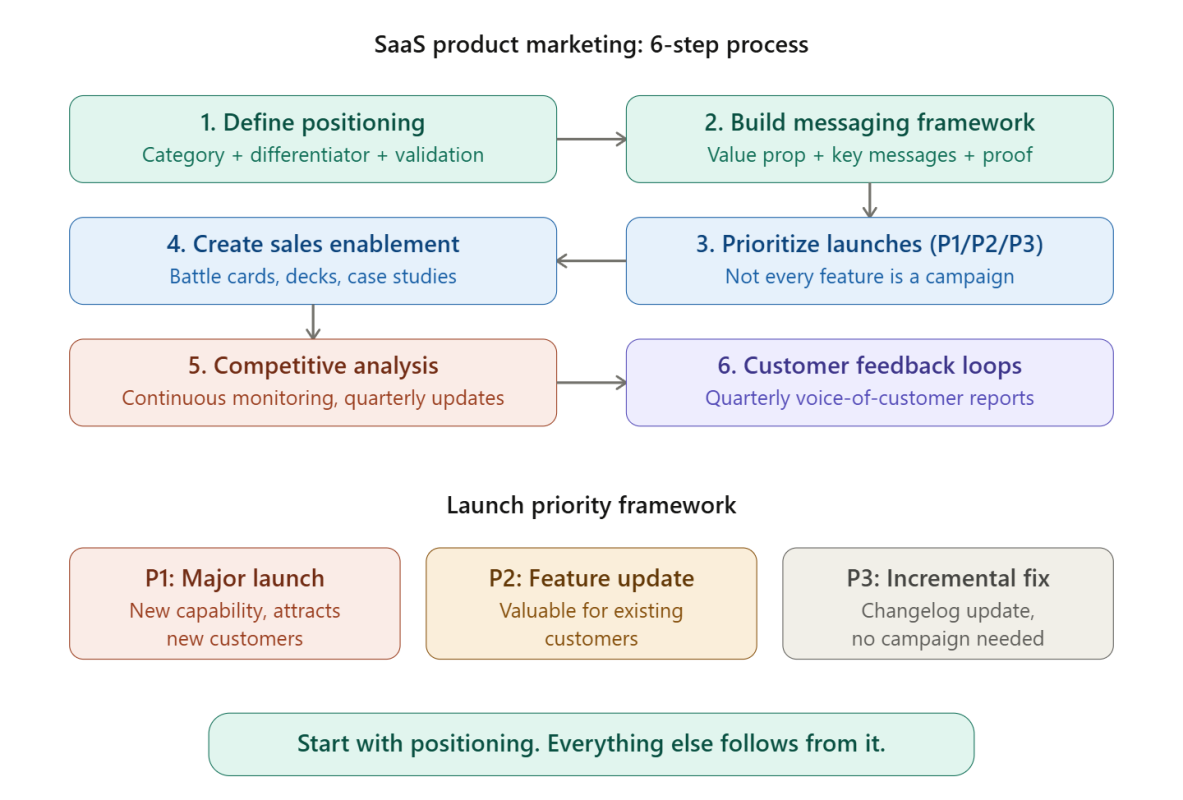
Step 1: Define Your Product Positioning
Positioning answers the question every buyer asks: why should I choose your product over everything else?
Identify Your Category
Place the product in a category the buyer already understands. “AI-powered helpdesk for SaaS companies” is clearer than “intelligent customer experience platform.” Buyers search for categories. Meeting them with familiar language reduces friction.
Articulate Your Differentiator
Every SaaS market has established players. Your differentiator is the specific advantage that matters most to your target buyer. Speed of implementation, a unique feature, pricing simplicity, or an underserved niche can all serve as differentiators.
A useful framework for positioning: “[Product] is a [category] that helps [target customer] [achieve outcome] unlike [alternative], which [limitation].”
Validate With Customers
Positioning created in a conference room without customer input often misses the mark. Interview 10 to 15 current customers and ask why they chose your product, what they considered instead, and how they describe the product to colleagues. The language customers use is often more compelling than the language marketers create. Working with B2B marketing agencies that prioritize customer research produces stronger positioning.
Step 2: Build Your Messaging Framework
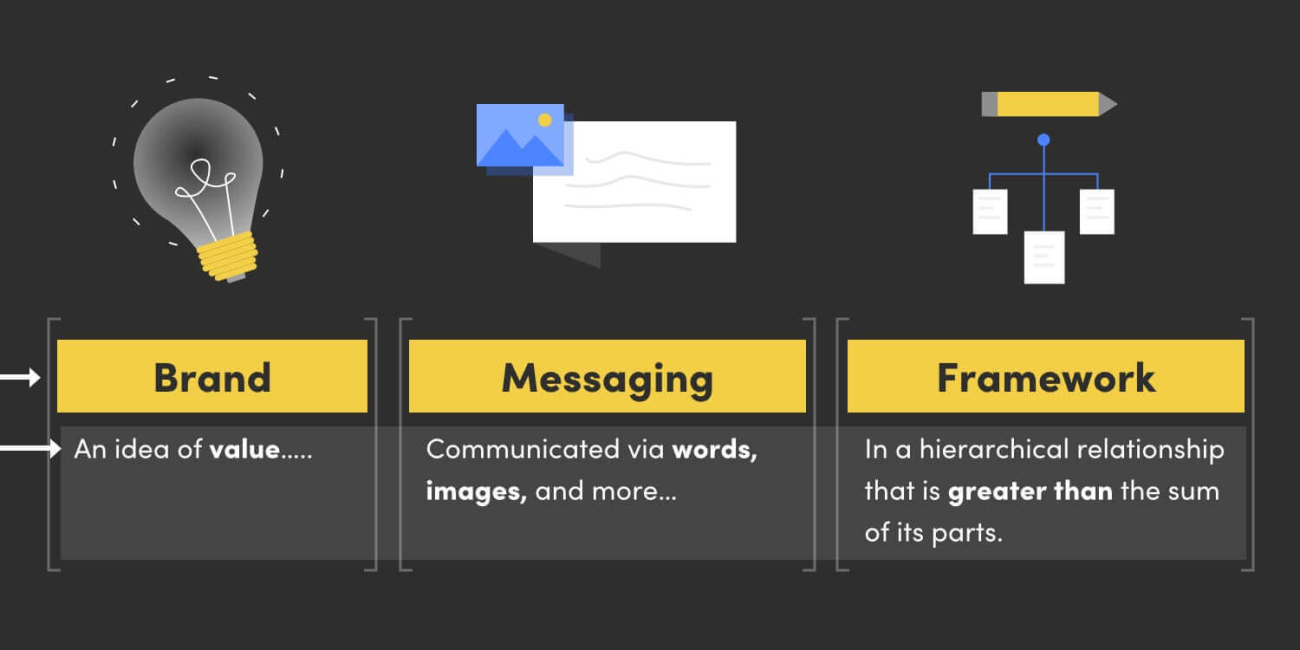
A messaging framework translates positioning into specific language that marketing, sales, and customer success teams use consistently.
Core Components
A complete SaaS messaging framework includes:
- Value proposition: One sentence summarizing the primary benefit
- Key messages: 3 to 4 supporting points that explain why the product delivers on the value proposition
- Proof points: Data, customer quotes, or case studies that validate each key message
- Audience-specific messaging: Variations for different personas (buyer, user, technical evaluator)
Consistency Across Channels
The messaging framework should inform every customer-facing asset: website copy, blog content, email sequences, sales decks, demo scripts, and ad copy. When a prospect reads the homepage, receives a sales email, and attends a demo, the core message should feel consistent, not contradictory.
Step 3: Prioritize Product Launches
SaaS companies ship features continuously. Not every release deserves the same level of promotion. A prioritization framework prevents announcement fatigue.
Use a P1, P2, P3 System
Rate each feature release on two axes: value to new customers and degree of innovation.
- P1 launches: Major new capabilities that attract new customers. Full campaign treatment with blog post, email blast, social push, press outreach, and in-app announcement.
- P2 launches: Valuable features primarily for existing customers. In-app message, email to relevant segments, and a blog post.
- P3 launches: Incremental improvements and bug fixes. Changelog update and optional in-app notification.
Most features are P3s. Treating every release as a P1 dilutes the impact of genuinely significant launches. Studying how content marketing agencies structure launch calendars for clients reveals this tiered approach in practice.
Step 4: Create Sales Enablement Materials
Product marketing’s most tangible output is the materials that help sales teams close deals.
Essential Sales Enablement Assets
- Battle cards: One-page competitive comparison sheets for each major competitor
- Sales deck: A 10-15 slide presentation covering the problem, solution, differentiators, and proof points
- Demo script: A structured walkthrough tailored to different personas
- Objection handling guide: Responses to the most common buyer objections
- Case studies: 2-3 page documents showing customer results with specific metrics
- ROI calculator: A tool that helps prospects quantify the value of switching
Sales reps who have access to strong enablement materials close deals faster because they spend less time improvising and more time having structured conversations.
Step 5: Run Competitive Analysis Continuously
Competitive analysis is not a one-time project. SaaS markets evolve quickly, and competitors update pricing, features, and positioning regularly.
What to Monitor
- Competitor product updates and feature launches
- Pricing changes and new tier structures
- Messaging changes on homepages and landing pages
- New content topics and keyword targets
- Customer reviews and common complaints on G2 and Capterra
- Hiring patterns that signal strategic shifts
Update battle cards and competitive positioning quarterly. Share competitive intelligence with sales, product, and marketing teams through a shared internal document or Slack channel.
According to Crayon’s 2024 State of Competitive Intelligence report, 90% of businesses say their industry has become more competitive in the last three years. Continuous monitoring is no longer optional. Tracking competitor SEO activity with the help of top SEO companies provides visibility into their organic strategy.
Step 6: Gather and Synthesize Customer Feedback
Product marketing serves as the voice of the customer inside the organization. Structured feedback collection informs positioning, messaging, feature prioritization, and competitive strategy.
Feedback Sources
- Customer interviews (quarterly, 10-15 per round)
- Win/loss analysis from closed deals
- Support ticket themes and feature requests
- Product usage data and adoption metrics
- Online reviews and social media mentions
Compile findings into a quarterly “voice of customer” report that product, marketing, and sales teams can reference. Patterns in feedback reveal what customers value most, where the product falls short, and what competitors are doing better.
Start With Positioning, Everything Else Follows
Product marketing is not a luxury for later-stage companies. Clear positioning and consistent messaging make every marketing dollar more effective from day one. Start by interviewing customers, defining what makes your product different, and building a messaging framework that the entire team uses.
Share your biggest product marketing challenge in the comments, or explore our guide to SaaS SEO agencies for help translating your positioning into content that ranks.
Frequently Asked Questions
What is product marketing for SaaS?
Product marketing for SaaS covers positioning, messaging, launch planning, sales enablement, competitive analysis, and customer feedback synthesis. The role ensures the right message reaches the right buyer at every stage.
When should a SaaS company hire a product marketer?
As early as possible. Ideally, a product marketing hire comes before or alongside the first content marketer. Positioning and messaging should be defined before scaling content production.
What is a product positioning framework?
A positioning framework defines the product’s category, target audience, primary benefit, and key differentiator. The format is: “[Product] is a [category] that helps [audience] [achieve outcome] unlike [alternative].”
How often should competitive analysis be updated?
Update battle cards and competitive positioning quarterly. Monitor competitor websites, pricing, and product updates continuously through alerts and regular check-ins.
What are the most important sales enablement materials?
Battle cards, a sales deck, demo script, objection handling guide, case studies, and an ROI calculator are the essential assets that help sales teams close deals consistently.
How does product marketing differ from demand generation?
Product marketing defines what to say and to whom. Demand generation focuses on driving leads and traffic. Product marketing creates the messaging foundation that demand gen campaigns are built on.